There are lots of things magazines I pretend not to subscribe to tell me about dating sites. I should never give out too much personal information too soon. I should do a search on someone I talk to who seems to be "too good to be true" because he probably is. I should run like the wind if someone I'm chatting with asks for money, even if he makes it sounds legitimate. The list goes on and on, and usually ends with the clarification that some people on dating websites are actually real and we shouldn't let all of theses risks deter us from true love. What? All of that is insane enough, but when you throw in strangers viewing my personal messages I don't even know if I want a sittercity.com account anymore. The internet is a scary place.
So while it should shock me to learn that OKCupid is appointing random moderators to comb through users' private information, sadly, it doesn't. The dating website is recruiting members--just regular old users trying to find love--to take a leadership role and try to weed out some of the scammers I already mentioned. That doesn't sound too bad until you find out that these moderators have access to users' private messages, photos, and more, all without the user knowing it. If possible, it gets worse from here: mods can repost the information they gather publicly without any repercussions and can ban or flag users they simply don't like who have done nothing against website policy.
And guess what? While this is all totally creepy and sounds like a Lifetime movie I watched for a total of five minutes while holed up in a hospital room a few months ago, it is all totally legal. It never states on the site that this won't happen, and as for the reposting of private exchanges, OKCupid says that it doesn't approve of that but can't help what the moderators do with their power.
This is one of the worst excuses I have ever heard. If the site wants its moderators to act in a certain way then it should make actual rules instead of tisk-tisking when the news breaks. OKCupid and sites like it are responsible for their users' trust and personal information. In this case, the site isn't even attempting to hide its shady policies in disclaimers we all just check "I Agree" for upon registration without reading. They're leaving it out completely.
So normally this is the place where I would sigh and admit that the user holds some responsibility as well. I would argue that these sites know that no one reads all of that legalese. I would explain how many internet users simply don't know where to find privacy agreements or that they have anything to worry about in the first place. I would say all of these things, but instead all I can say is that OKCupid has done its users an even greater disservice in leaving this all secret altogether.
People expect privacy. They expect that there are laws protecting them and their messages and information from prying eyes. There just aren't. It is up to users and site managers, and in this case, the site never said anything was private so nothing is. It is opposite to the assumptions most people make about their privacy, sort of an innocent until proven guilty thing. Private until notified otherwise.
This is disgusting, and although the site has changed the amount of information its mods can see, it is simply not good enough. When users sign up they are signing their privacy away without ever knowing it.
Sunday, March 31, 2013
Monday, March 18, 2013
Blog Post #3: Conflict and Warfare in the Digital Age
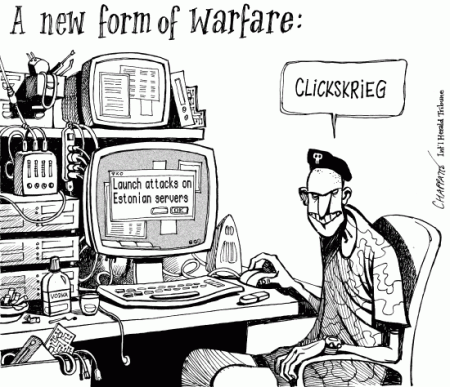
The Cold War is literally old news. Many people who did not live through it know it as the time America was afraid of nuclear warfare. We know that students performed drills in which they hid under their desks, because that would obviously save them from a nuclear bomb. How quaint. Simply adorable. Yet generations too young to remember such things miss not only the seriousness of that time period but also that of our own, nicknamed the Cool War. This is not slang. This does not mean that the war is popular and has lots of people asking it to prom. What it does mean, however, is that the wonderful technology we carry in our pockets and stockpile on desks around the world also opens a new door for wars-that-are-not-wars.
Our technology is so user-friendly, so trusted, and so easy to hack. This goes for countries around the world, including those looking to attack others without leaving a clear trail behind them. For example, U.S. computers containing confidential information have been attacked by users in China and in Russia. Because there is no face-to-face aspect and no public figure publicly leading the way, there is no solid way for American intelligence agencies to know who exactly launched an attack on us. Was it the government? Rogue citizens? Underground civilian cyber warfare groups?
Without someone to hold accountable, this Cool War remains just that. If these had been declared government acts America would be forced to react much more strongly than it has and possibly start a full-out, physical attack in retaliation, thrusting the countries into "actual" war. Because of the anonymity afforded to us all by technology, authorities do not have confirmation that the governments were involved in these attacks. The last thing the world needs is a war brought on by a misunderstanding, by an assumption that governments were attacking other countries when it was actually small cells of civilians or even individuals.
Another issue we face in this Cool War is secrecy within individual nations. The Cool War remains cool in part because everyday citizens are rarely aware of attacks waged on their home countries. If someone were to break into an official Washington D.C. government building and steal sealed documents Americans would know about it. There would be a call for action. When sealed documents stored digitally in that same building are stolen online, it is easier for our government to keep it quiet and keep us calm. Calm, ignorant, and docile. Perhaps it is better that way, at least for our government, but it seems that citizens have a right to know if they are under attack. Ignorance is not bliss when it comes to any type of warfare.
Citizens need to be made more aware of the Cool War and our nation must continue to improve its possibly vulnerable systems.
Our technology is so user-friendly, so trusted, and so easy to hack. This goes for countries around the world, including those looking to attack others without leaving a clear trail behind them. For example, U.S. computers containing confidential information have been attacked by users in China and in Russia. Because there is no face-to-face aspect and no public figure publicly leading the way, there is no solid way for American intelligence agencies to know who exactly launched an attack on us. Was it the government? Rogue citizens? Underground civilian cyber warfare groups?
Without someone to hold accountable, this Cool War remains just that. If these had been declared government acts America would be forced to react much more strongly than it has and possibly start a full-out, physical attack in retaliation, thrusting the countries into "actual" war. Because of the anonymity afforded to us all by technology, authorities do not have confirmation that the governments were involved in these attacks. The last thing the world needs is a war brought on by a misunderstanding, by an assumption that governments were attacking other countries when it was actually small cells of civilians or even individuals.
Another issue we face in this Cool War is secrecy within individual nations. The Cool War remains cool in part because everyday citizens are rarely aware of attacks waged on their home countries. If someone were to break into an official Washington D.C. government building and steal sealed documents Americans would know about it. There would be a call for action. When sealed documents stored digitally in that same building are stolen online, it is easier for our government to keep it quiet and keep us calm. Calm, ignorant, and docile. Perhaps it is better that way, at least for our government, but it seems that citizens have a right to know if they are under attack. Ignorance is not bliss when it comes to any type of warfare.
Citizens need to be made more aware of the Cool War and our nation must continue to improve its possibly vulnerable systems.
Saturday, March 2, 2013
Blog Post #2: The Digital Divide and Internet Learning
The internet is increasingly required in modern-day American education and is undeniably valuable for today's students. According to USA Today, however, only 57 percent of South Carolina homes have broadband access. This puts children living in these homes at a disadvantage right out of the gate, especially for students whose teachers are employing methods like Greenville math teacher Jennifer Southers'. Southers posts her lectures online for students to watch and uses class time for work, when her students can ask her questions and work through issues instead of trying alone as homework.
This is an interesting idea, and one Southers reports to suit her students better than traditional learning. But what of students residing in the 43 percent of S.C. homes without the web? How can they possibly be expected to complete their in-class assignments without access to the accompanying lessons? How can they compete with their classmates in the other 57 percent?
There is a simple and depressing answer: they can't. Those arguing against the existence of this digital divide have plenty of "answers" for these students and those like them. There are libraries providing internet access. There are cafes and even fast food chains advertising free wi-fi for customers. The list of purported solutions goes on, and each answer is just as out of touch with reality as the last.
The truth is that libraries are not enough. Internet sessions there are usually timed, carefully monitored, and otherwise restricted in ways home sessions are not. In areas predominately without home internet access, Southers' students are certainly not the only people hoping to get online. There may be long waiting lists that stretch until the library closes (which, incidentally, is usually earlier in poorer areas--the same areas with limited home internet access). Students do not get enough time on the computer at the library if they are able to get on at all, a far cry from their peers equipped with home computers linked to the internet.
The Starbucks Solution is even worse. There are often time limits in restaurants offering free wi-fi, but that is far from the worst part of this supposed answer to the digital divide. When thought about logically, the idea that a student lacking basic internet in her home owns a working laptop, iPad, or other portable device with internet capabilities seems far-fetched, to say the least. Panera Bread is not handing you a Macbook along with your soup, so how are students supposed to utilize the internet at these places? Free wi-fi doesn't do you much good when you don't have a device to connect.
Add in possible transportation and supervision issues for students of varying ages and it's enough to put a giant X through these attempts at denying the digital divide's existence and impact.
Let's stop kidding ourselves. Internet learning can be a very useful tool, but without all students having the same level of access the whole concept is impossibly flawed. For Southers' students to benefit from her innovative teaching ideas, South Carolina needs to close the digital divide and raise that 57 percent of homes with internet access to 100 percent. The rest of the nation must follow suit or leave these people behind.
| Southers using digital technology in her classroom |
This is an interesting idea, and one Southers reports to suit her students better than traditional learning. But what of students residing in the 43 percent of S.C. homes without the web? How can they possibly be expected to complete their in-class assignments without access to the accompanying lessons? How can they compete with their classmates in the other 57 percent?
There is a simple and depressing answer: they can't. Those arguing against the existence of this digital divide have plenty of "answers" for these students and those like them. There are libraries providing internet access. There are cafes and even fast food chains advertising free wi-fi for customers. The list of purported solutions goes on, and each answer is just as out of touch with reality as the last.
The truth is that libraries are not enough. Internet sessions there are usually timed, carefully monitored, and otherwise restricted in ways home sessions are not. In areas predominately without home internet access, Southers' students are certainly not the only people hoping to get online. There may be long waiting lists that stretch until the library closes (which, incidentally, is usually earlier in poorer areas--the same areas with limited home internet access). Students do not get enough time on the computer at the library if they are able to get on at all, a far cry from their peers equipped with home computers linked to the internet.
The Starbucks Solution is even worse. There are often time limits in restaurants offering free wi-fi, but that is far from the worst part of this supposed answer to the digital divide. When thought about logically, the idea that a student lacking basic internet in her home owns a working laptop, iPad, or other portable device with internet capabilities seems far-fetched, to say the least. Panera Bread is not handing you a Macbook along with your soup, so how are students supposed to utilize the internet at these places? Free wi-fi doesn't do you much good when you don't have a device to connect.
Add in possible transportation and supervision issues for students of varying ages and it's enough to put a giant X through these attempts at denying the digital divide's existence and impact.
Let's stop kidding ourselves. Internet learning can be a very useful tool, but without all students having the same level of access the whole concept is impossibly flawed. For Southers' students to benefit from her innovative teaching ideas, South Carolina needs to close the digital divide and raise that 57 percent of homes with internet access to 100 percent. The rest of the nation must follow suit or leave these people behind.
Subscribe to:
Comments (Atom)